Walter Shandy
The Life and Opinions of Tristram Shandy, GentlemanWalter Shandy is Tristram’s father, a retired Turkey merchant whose orderly habits and restless theorizing make him both the household’s principal authority and a recurring source of comic miscalculation. He tries to interpret family life through systems—schedules, contracts, philosophy, and theories of names—yet the novel repeatedly sets those systems against interruptions and circumstances he cannot control. His confidence in reasoning coexists with impatience, grief, and a markedly tender concern for his son’s future.
Identity and Habits
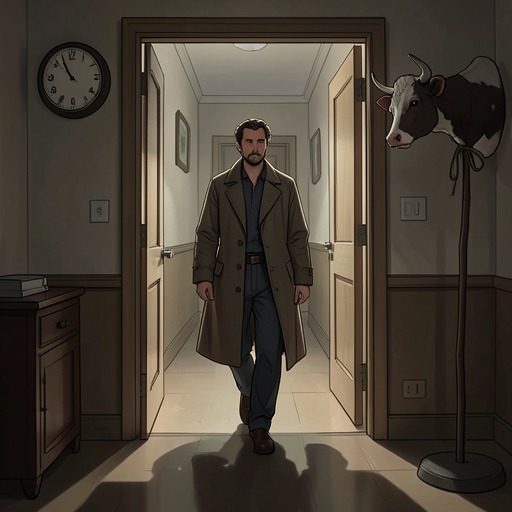
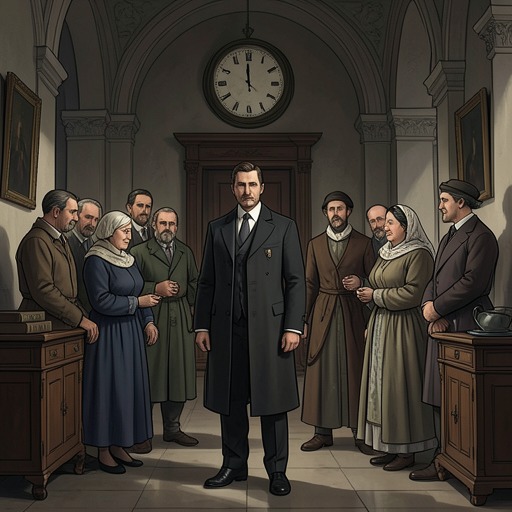
Before retiring to his paternal estate, Walter had been a Turkey merchant. In later life he was, in Tristram’s account, exceptionally regular in both business and amusement, so much so that he had become a slave to exactness. On the first Sunday night of every month, throughout the year, he personally wound a large house-clock standing at the head of the back stairs. The ritual supplies a practical measure of his character: time is not merely something he observes but something he tries to order through repeated acts.
The clock also becomes the emblem of the mismatch between his carefully maintained routines and domestic conversation. When his wife asks whether he has forgotten to wind it, Walter is in the middle of speaking; he moderates his exclamation even as he resents the interruption. Asked what he had been saying, he answers, “Nothing.” The exchange punctures his sense of a continuous, important train of thought: a domestic question can stop it, and the answer left behind is an absence.
His intellectual self-image is substantial. Tristram presents him as a man of good sense, philosophical curiosity, and ability in political and theological argument. Yet this learning does not protect him from convictions that others might find extravagant. The narrator singles out Walter’s theory of Christian names: he believes that good or bad names exert a powerful, nearly irresistible bias on character and conduct. Walter treats the choice of a name not as a superficial formality but as a matter with consequences for a person’s life.
Family Systems and Disagreements
Walter’s marriage to Elizabeth Mollineux is governed in part by a formal settlement. In the document, he agrees with the named trustees to provisions linked to the marriage and to the possibility that he may leave business before his wife has ceased bearing children. The legal language makes family arrangements look precise and durable, another instance of Walter’s reliance on systems to manage contingencies. The contract’s existence does not make family life predictable; instead, it establishes the practical and domestic framework against which his plans and expectations can be tested.
His differences with Elizabeth often turn on the distinction he insists upon between pleasure and convenience. When the couple debate putting their boy into breeches, Walter opens the subject as a formal domestic consultation. He later loses his temper because, as he sees it, his wife has failed to distinguish those two kinds of consideration. The narrator then closes the chapter by observing that it was Sunday night and that the chapter says no more. The abrupt stop mirrors the limits of Walter’s own effort to make a household decision settle neatly into reasoned categories.
Walter’s ordered manner also surfaces in his treatment of other family questions. He can turn a practical matter into a debate, seek learned authority for it, and become frustrated when the authority fails to provide the answer he wants. After discussing the breeches with Elizabeth, he consults Albertus Rubenius, whose book concerns ancient clothing. Walter cannot extract from the learned work even a single useful word on the subject. Scholarship, summoned to settle a domestic question, becomes another system that promises guidance but withholds it.
Fatherhood, Names, and Misfortune
Walter’s theory of names is bound up with his hopes for Tristram. He believes that names impress a lasting bias upon character and conduct, yet he insists that his aspirations for his child were not grandiose: he says he would have been content to give him a name such as George or Edward. His concern is therefore not simply for distinction. He imagines that a name can shape the course of a life, and he fears the consequences of a choice that might work against his son’s prosperity.
That fear becomes painfully vivid when he speaks to his brother, Toby. Walter describes human life as burdened by affliction and misfortune; Toby interrupts by saying that he was born to nothing but his commission. Walter counters that their father left Toby an income of one hundred and twenty pounds a year, but dismisses this as another matter and returns to the larger question of how the mind endures life’s troubles. The exchange reveals a characteristic contrast: Toby answers in the particular terms of his own history, while Walter tries to gather individual experience into a general account of human suffering.
The naming question sharpens Walter’s sense that the family’s troubles have accumulated around his child. He complains that Heaven has directed its heaviest artillery at the boy’s prospects and calls Tristram a child of wrath, decrepitude, interruption, mistake, and discontent. The language is deliberately expansive: misfortune becomes a campaign, the child’s prosperity its target, and Walter’s household a place where one setback seems to summon another. His theory of names gives this anxiety an intellectual framework, but it also magnifies his fear that a seemingly small mistake can shape an entire destiny.
At the moment of christening, the elaborate question of a name becomes an urgent practical confusion. Susannah reports that the child is in a fit and that the curate is waiting with him in the dressing room for a name; Elizabeth has sent her to ask whether he should be named after his godfather, Toby. Walter asks for his breeches, only to be told that there is no time to dress him. The scene places his concern for proper arrangements beside an immediate family emergency, and lets the practical rush interrupt the long theoretical debate that preceded it.
Philosophy, Temper, and Conversation
Walter’s conversations with Toby expose the gap between his appetite for general principles and his brother’s shorter, more concrete replies. When Walter considers how the mind withstands the burdens of life, he attributes endurance to hidden resources and begins to invoke divine assistance; Toby’s interruptions return the discussion to his commission, his income, or the immediate subject at hand. Their exchanges do not simply oppose a thinker to a non-thinker: Toby’s plainness repeatedly tests Walter’s abstractions against lived circumstance, while Walter keeps trying to make those circumstances part of a larger account.
A similar pattern appears in Walter’s treatment of time. After a rapid succession of ideas and a discourse that darts from one topic to another, he remarks that the interval seems an age. The narrator explains that Walter could have accounted for this impression through a metaphysical dissertation on duration and its simple modes, tracing how the succession of ideas and the brain’s measurements lengthen a short period. The joke lies in the difference between what he says spontaneously and the elaborate explanation he was already prepared to give: even a passing impression becomes an opening for theory.
Walter’s temper complicates his disciplined self-presentation. Tristram says he was subject to impatience even before marriage and that, when something vexed him, he would not submit to it calmly. The narrator also describes a particular irritation that could keep Walter from rest for several nights and provoke him to write bitter verses against the offending eye. This evidence presents his anger as both comic and consuming: the man who tries to order daily life can be unsettled by a small provocation and answer it with sustained literary effort.
His occasional despair is more serious. When matters go badly, Walter wonders why he was begotten and wishes himself dead; under stronger provocation, Tristram says, his words could resemble the sentiments of Socrates, expressing disdain for life and indifference to its consequences. The narrator connects this tendency with Walter’s habit of returning to philosophical reflection when grief presses him. His learning supplies language for distress, but does not necessarily relieve it.
Learning, Travel, and Narrative Function
Walter’s engagement with learning is practical as well as speculative. On a winter night, after spending three painful hours translating a work by Slawkenbergius, he marks his place with Elizabeth’s threadpaper and tells Toby that it is a pity for truth to remain shut up in impregnable strongholds rather than yield under a close siege. The military image converts scholarship into a campaign. It also links Walter’s intellectual labor to the language of attack and persistence that he uses elsewhere to describe adversity.
His curiosity accompanies travel. At the Abbey of Saint Germain, he agrees to go and see the bodies recommended by Monsieur Sequier. Toby is willing to see anything, while Walter clarifies that the bodies are mummies and jokes that it will be more fitting to visit them with their beards on. The party sets out with the corporal lending Toby his arm and bringing up the rear. Walter’s learned interest is thus part of a shared excursion, shaped by his brother’s readiness to comply and by the practical company that accompanies them.
Walter’s disagreements and speculations give the novel a domestic counterpoint to its adventures and digressions. He turns a clock-winding into a symbol of regularity, a child’s clothing into a debate over pleasure and convenience, and a name into a theory of destiny. Yet each system is exposed to what it cannot fully contain: a spouse’s question, an unhelpful book, a brother’s interruption, a child’s emergency, or the unpredictable force of sorrow. He is neither simply the rational authority he imagines himself to be nor merely a bundle of eccentric opinions; his care for Tristram and his fear for the boy’s future lend emotional weight to the comic machinery of his reasoning. His narrative importance lies in that tension: he tries to explain and regulate life, while the story keeps showing how life interrupts explanation.